For drilling crews, casing cleaning is not just about scraping the casing wall. It is about completing the job safely, reducing rig time, maintaining circulation, and getting the BHA back to surface without unnecessary risk.
Traditional fixed-blade scrapers are simple and widely used, but they also have limitations. The blades are always exposed, which may increase drag during running and retrieval. In some operations, multiple trips may be required for drift checking, scraping, circulation, and displacement. In complex wellbore clean-up programs, this means more rig time, more operational exposure, and higher cost.
TORRENT OIL TOOLS developed two advanced casing scraper solutions to address these field challenges:
Both tools are designed to help drilling and completion teams complete drifting, casing scraping, circulation, and displacement in one run, while allowing the scraper blades to retract for safe retrieval.
From Conventional Scraping to One-Trip Clean-Up
In many clean-up operations, the ideal workflow is simple:
Run in hole.
Confirm passage.
Activate the scraper.
Clean the casing.
Circulate and displace the well.
Retract the blades.
Pull out safely.
This is exactly the field logic behind TORRENT’s activated scraper design.
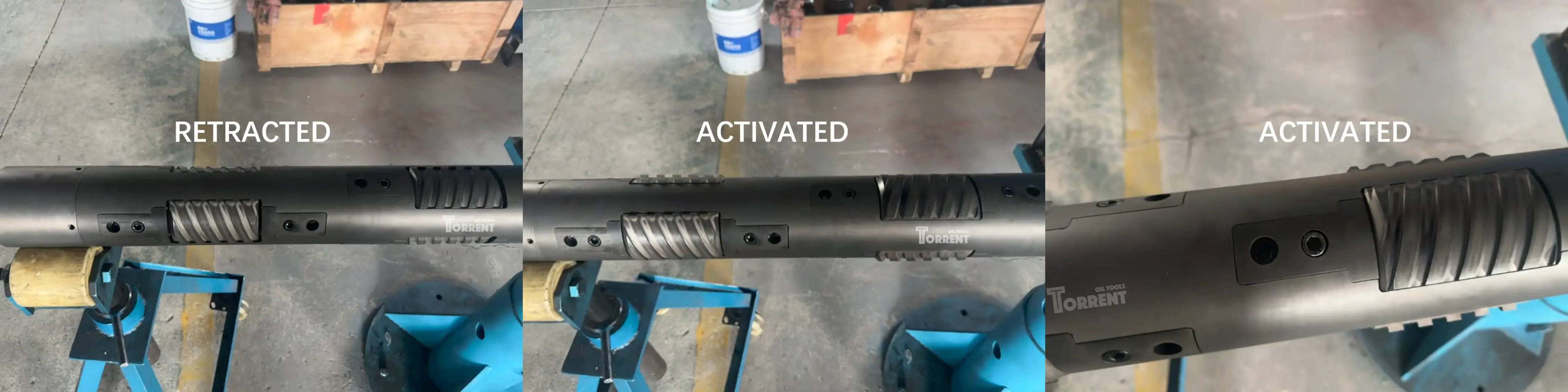
Instead of using a traditional fixed-blade tool that remains engaged throughout the entire trip, the activated scraper keeps the blades retracted while running in hole. The blades are only extended when scraping is required. After the clean-up operation is completed, the blades can be retracted again before pull-out-of-hole.
This makes the tool more suitable for one-trip casing clean-up operations where drifting, scraping, circulation, and displacement are expected to be completed in a controlled sequence.
Ball-Activated Hydraulic Casing Scraper
The ball-activated hydraulic casing scraper is designed for operations where the drilling crew or completion team wants clear, positive activation from surface.
The tool is activated by dropping a ball and applying hydraulic pressure. Once activated, the scraper blades extend and contact the casing wall. After scraping and displacement are completed, a second ball can be used to shift the internal mechanism, retract the blades, and prepare the tool for safe retrieval.
For advanced wellbore clean-up operations, this type can also be designed with a bypass downward flow path. This allows downward communication to the lower BHA or bottom-hole section after activation. As a result, the crew can continue circulation and perform whole-well displacement after scraping, instead of losing communication to the lower section.
This design is particularly useful when the operation requires a defined activation point, controlled deactivation, and post-scraping displacement in the same run.

Hydraulically Actuated Casing Scraper
The hydraulically actuated casing scraper is designed for simpler pressure-controlled operation.
This tool does not require ball dropping for normal scraping. The scraper blades extend when circulation pressure reaches the activation range and retract when pressure is reduced or circulation is stopped.
For drilling crews, the advantage is operational simplicity. The tool can be controlled by pump rate and pressure, reducing the number of activation steps and minimizing the risk of ball seating issues.
This type is suitable for casing cleaning operations where the operator wants a simple, reliable, hydraulically controlled scraper that can be activated and recovered by pressure control.

Flexible Selection According to Well Conditions
There is no single scraper design that fits every well.
For this reason, TORRENT offers both ball-activated and hydraulically actuated scraper options. The most suitable configuration can be selected according to the customer’s wellbore conditions, casing program, pump capacity, BHA design, and clean-up procedure.
The ball-activated type is preferred when the customer requires clear sequential control, positive activation, deactivation, or bypass flow-path functions.
The hydraulically actuated type is preferred when the customer wants a simpler pressure-responsive tool with fewer surface activation steps.
Both types can also be combined in one BHA when the job requires multi-section casing cleaning. For example, one scraper may be used for a smaller casing section and another scraper for a larger casing section, with different activation logic to avoid simultaneous operation.
This allows multi-interval clean-up to be performed in one run, helping reduce rig time and improve job efficiency.
Optimized Blade and Retraction Design
A scraper blade must do two things at the same time: it must clean aggressively and still return safely after the operation.
TORRENT’s activated scraper tools are designed for high-strength casing scraping while maintaining reliable blade retraction. The blade structure is optimized to remove cement residue, mud cake, scale, rust, and other hard deposits from the casing ID during reciprocation.
At the same time, the blade pocket and retraction mechanism are designed to reduce the risk of scraped debris entering between the blade and the tool body. This is critical in field operations, because debris trapped in the mechanical structure may prevent blade retraction and create difficulty during pull-out-of-hole.
By optimizing the blade geometry, blade pocket clearance, and activation / retraction structure, the tool provides strong scraping performance while improving retrieval reliability.
The purpose is not only to scrape harder, but to scrape safely.
Why This Matters to the Drilling Crew
For the drilling crew, the benefit is practical:
- Fewer trips
- Less rig time
- Controlled scraper activation
- Safer retrieval after cleaning
- Ability to combine drifting, scraping, circulation, and displacement in one run
- Optional downward bypass flow path for post-scraping whole-well displacement
- Flexible selection between ball-activated and hydraulically actuated designs
- Possibility to combine multiple scrapers for multi-section clean-up
These are not just tool features. They are operational advantages.
A casing scraper should not become the source of additional risk. It should help the crew complete the clean-up program with better control, fewer trips, and higher confidence.
Designed for Modern Wellbore Clean-Up
Modern drilling and completion programs require more than a simple fixed-blade scraper. They require tools that can adapt to the operation.
TORRENT’s ball-activated and hydraulically actuated casing scrapers are developed for one-trip wellbore clean-up applications. By combining retractable scraper blades, controlled activation, reliable deactivation, and optional bypass flow capability, these tools provide a more efficient and safer alternative to conventional casing scraping methods.
Whether the job requires simple pressure activation, positive ball-drop control, downward flow communication, or multi-section scraping in one run, TORRENT can provide a customized scraper solution according to the customer’s field requirements.